The House of the Mind and the Expanded Concept of Art.
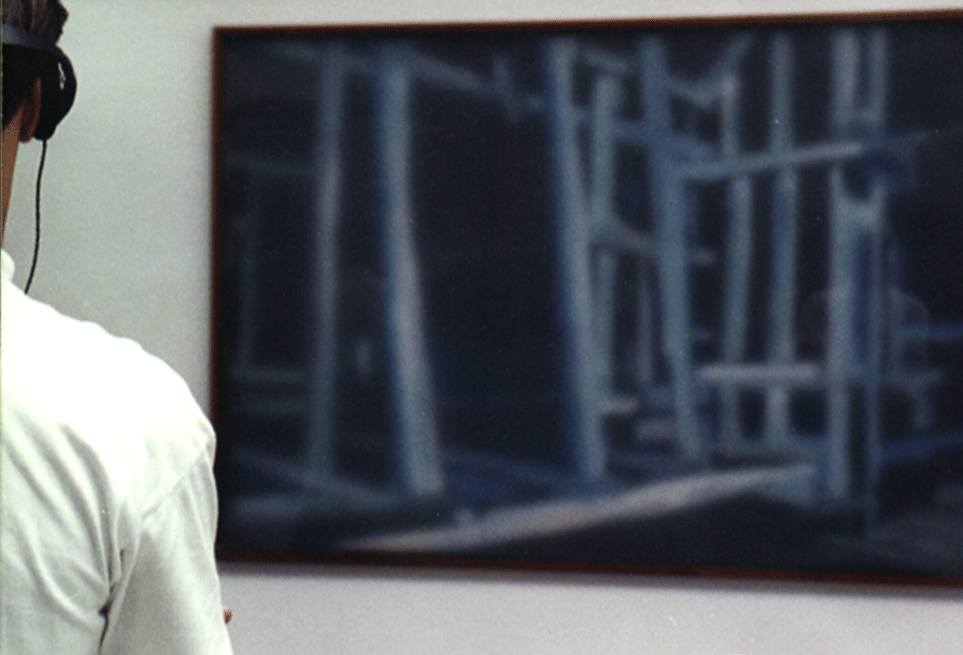
Title: The Veiled and the Revealed:(Oil painting on wood, 78.74 in x 39.37 in, diffuse acrylic over the work. Year: 1999. Installation with recording and headphones). Presented at the Jacobo Borges Museum in 1999 and at the Tulio Febres Cordero Cultural Center in Mérida. The image: “The Access”: Beginning of the construction of a door and a room in the house of the mind. Work owned by the international art collector Iván Vivas Gari, Tovar, Mérida State, Venezuela.
The installation included a recording made before covering the image with acrylic, in which the voices of three renowned critics could be heard. They were the only people to see the work in its original state. Once the acrylic was applied, the oil painting became veiled forever: it could never again be contemplated in its fullness, for from then on it would only be visible as an image distorted by the haze of the diffuse acrylic.
Thus, what remains is a veiled work, more poetic but an image disfigured by the veil of the material, accompanied only by the analytical record of the critics. They left behind an interpretation recorded on tape of a work that the viewer can no longer see in its entirety.
This proposal denounces, in 1999, the over-verbalization characteristic of our culture, contrasting it with the visual contemplation of things — in short, the necessary balance between explanation and poetic or spiritual knowledge, as exemplified in the thought of Saint Thomas Aquinas and Saint Francis.
The Collapse of Modernism
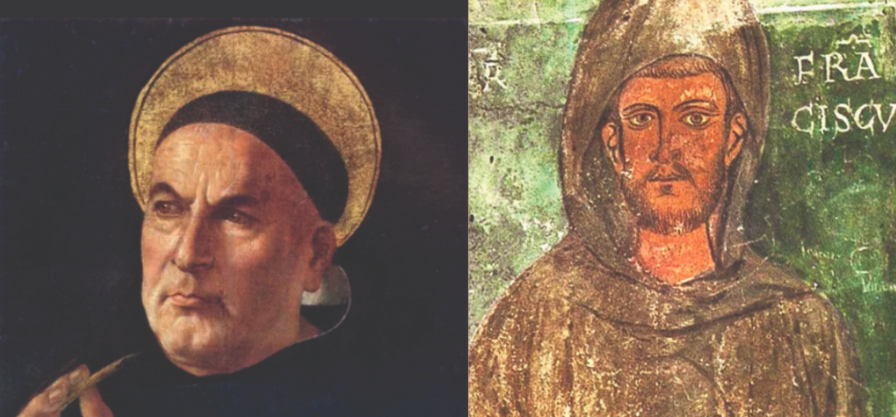
“Saint Thomas Aquinas and Saint Francis of Assisi: The Left and Right Hemispheres of the ‘Brain’ of Western Civilization Thought. Representing the rational and mystical sides of the Western intellectual tradition”
Now people see without looking; they have only a physiological or superficial biological gaze upon things. Reality is viewed through ideologies. The mental concept has become a structural and cultural phenomenon that inhibits the capacity for analysis and contemplation.
Modernity has collapsed, leaving only the return to the thought that gave birth to Western civilization: the convergence of the three hills —Greece, Jerusalem, and Rome— to rediscover a logic that aligns with the objective interpretation of reality.
Drawing a tree from the concept:”Tree”, and drawing a real Tree from observation exercise. 2001
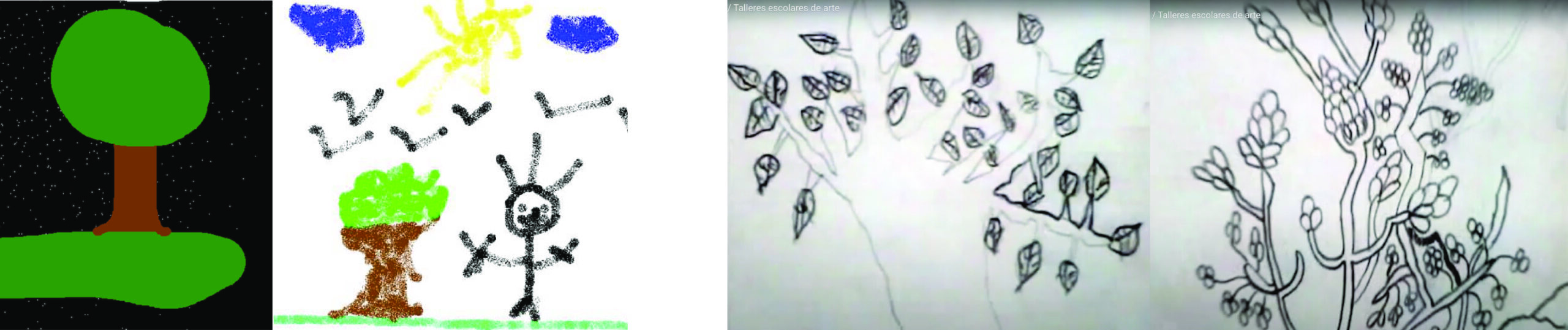
The piece derives from earlier works, A Drawing of a Tree and A Real Tree (an academic drawing exercise). Both later evolved within basic education as the foundation for this way of thinking, which emphasizes theoric hyperstimulation as a response to the diminished capacity for visual contemplation.
These exercises and artworks eventually gave rise to La Buena Gripe and Ideo Arte in the field of education. As art in elementary and secondary schools became increasingly hypertextualized, it became necessary to introduce real experiences that teach how to see and think in balance with the act of making art, achieving high-quality results suitable for museums, as well as musical outcomes worthy of today’s concert halls.
A.- To See
It is a passive act: to perceive something with the eyes without necessarily paying attention.
It is a physiological function: light reaches the retina, and the brain interprets shapes and colors.
Example:
“I see a tree from the window.”
(The tree is there, and you simply perceive it.)
B.- To Look
It is an active and voluntary act: it implies attention, intention, and concentration.
It involves interest, analysis, or contemplation.
Example:
“I look at the tree to study its form.”
“Here there is a will to observe, understand, or feel, and to discover with surprise that it’s a living being.”
The Expanded Concept of Arts
The House of the Mind – Learning to Observe and Listen Through a Creativity System
Cultural work of Art: Systems, programs, operations, and results.
LA BUENA GRIPE
1999 – 2000
In 1999, Pablo Díaz-Carballo and Arelis Díaz established their Conceptual Art Laboratory in Mérida, based on the Expanded Concept of Art, and founded “La Buena Gripe.” In 2001, after moving to Caracas, it evolved into IDEO ARTE, originating from his painting as a conceptual artwork, described as “a cultural antivirus to treat individuals with cultural disorders.” This approach became necessary as the country was undergoing an attack through cultural marxism.
IDEO ARTE
2000 – 2016
Pablo Díaz-Carballo developed a Conceptual Art project applying the Expanded Concept of Art to shape students’ minds through workshop experiences focused on the importance of art, and the fundamental question: What is art? This concept and its related microenterprise, La Buena Gripe, with Arelis Díaz, were presented in 1999 in a solo exhibition at the Mariano Picón Salas Gallery of the Tulio Febres Cordero Cultural Center in Mérida.
Two years later, upon returning to Caracas, they formally created IDEO ARTE, meaning “Thought and Creation.” In 2014, after being forced into exile, they continued their work through the IDEO ARTE Foundation, officially registered in a province of the Kingdom of the Netherlands. Through this initiative, they developed projects in Willemstad, a province of the Dutch Caribbean.
This initiative operated for fifteen years within the school education system, leading to a temporary intervention and the modification of the official Art in Basic Education curriculum.
La Buena Gripe – Ideo Arte (The Good Flu – Ideo Art) was a conceptual artwork developed by Pablo Díaz-Carballo under the Expanded Concept of Art. Within the students’ minds, this work sought to enhance creative thinking through new experiences centered on the question: What is art?
Through workshops inspired by the principles of contemporary art—and by treating the mind itself as an object of art—students learned to shape thought and emotion, transforming primitive energy into a new architecture of thinking open to creativity.
For example, they learned to view failed attempts as part of the path to success; to transform primitive rage into channeled strength; to convert the cry into song, chaos into order; and competition into cooperation—since competition was to be against oneself, not others. In short, the plasticity of ideas was like clay, and the flexibility of thought like painting.
The purpose of this process was to elevate the arts and music within basic education to a level of importance at least equal to that of science or sports.
“This is not a Pipe” René Magritte

Magritte: Surrealism – Jackson Pollock: Expressionism – Cognitive Neurophysiology’s – The House of the Mind.
“Pablo Díaz Carballo and His Expanded Concept of Art Project: The House of the Mind”
“This is not a school”
While in the Netherlands, forced into exile from 2014 until 2019 in Willemstad, he worked with 150 students from a public school and 35 from a private Dutch school. In the USA, he worked with 15 students using the same programs.
Ideo Arte functioned as a conceptual art laboratory, focusing on the question: “What is art?”
Legally, Ideo Arte operated as a non-profit organization dedicated to working with the Expanded Concept of Art and redefining established artistic and cultural boundaries through innovative educational programs.
Download CATALOG – PDF
https://www.pablodiazcarballo.com/wp-content/uploads/2025/03/01_HIST_ENG-OPTICompres.pdf
“Conceptual Foundations of The House of the Mind”
Click on the large image to see the content
USA
2019

WILLEMSTAD
2014 – 2019
CARACAS
1999 – 2016